I once received two separate gifts of the novel Moby Dick. These two editions of the novel sat happily on my shelf for a number of years before I finally picked one of them up to read for the first time. I selected as my reading copy the Oxford World’s Classics edition, a hardback with the nice dustjacket and the prestigious imprimatur of the Oxford University Press.
The less-prestigious paperback Wordsworth Classics edition sat on the shelf.
So I read Moby Dick, and I enjoyed it a great deal, and when I came to the end I thought, well, what an ending! And then I thought – hang on, what about Ishmael? Moby Dick’s opening, Call me Ishmael, is among the most renowned in literature. Surely the novel couldn’t end with Ishmael from the first line going unmentioned for the last hundred pages!
Luckily, I had my Wordsworth Classics edition to hand, and I pulled it out and found that the prestigious OUP had somehow managed to omit the last part of the book. They forgot to put the ending in. Whoops.
All of which demonstrates two valuable lessons which we can henceforth generalise into everyday life and apply to our every endeavour:
(1) you can judge a book by its cover (the Wordsworth said ‘complete and unabridged’ on the front, and the OUP did not)
(2) sometimes insignificant differences turn out to be quite significant after all.
For those also in possession of the OUP edition, I reproduce the omitted section below the jump.
Category: Uncategorized
Toi Te Papa (and Wisdom)
How busy have I been? I have been so busy that I have had a comic in my bag for ten days and still haven’t read it. I’m even blogging instead. But I’ll read it before I finish this post, then write about it, how about that?
Today Cal and I spent ninety minutes wandering through Toi Te Papa, the NZ art exhibition at the national museum. It was time well-spent. There was a cornucopia of material on show, and it was good to see so much incredible work by names that are legendary here – Ralph Hotere, Rita Angus, Colin McCahon being three whose works made predictably big impressions on this viewing. There was a degree of incoherence in the exhibition, cramming photography and pottery and sculpture and historic carving and painting and more all together; the point is obviously to gather all our artistic output together into one narrative, but in practice I felt that it didn’t do justice to any of the disciplines but the dominant one, painting. But this is a small point – it’s an accessible and fun exhibition with some real heavyweight stuff.
However, the thing that slowly sunk in as I wandered was how much the artworks resonated with me because, on a deep cultural level, I understood them. I didn’t need the references explained. The landscapes, the colours, the motifs, most of the politics, almost all of it was familiar or transparent to me. I actually felt at home in this exhibition as I never have in an art exhibition before, which was a surprise, because I came to love trawling art galleries while in Europe and I never appreciated the extent to which I was an outsider there. Here I was suddenly an insider.
It was a surprisingly rich experience. It reminded me of how when I first arrived in the U.K. I noticed countless tiny things that I had internalised as a child, reading British comics and watching British TV shows. These were things that I had never even registered as culturally specific until I was there and seeing them repeated in front of me. All of that pop-art I had inhaled as a kid suddenly became richer and more powerful in hindsight, because I saw that it wasn’t pulling its references out of thin air, but was instead part of a thick cultural context. Things were that way for a reason.
—
And with that deft segue into comics…
Wisdom issue 2, written by Paul Cornell, drawn by Trevor Hairsine. Amusing Warren Ellis pastiche with spotty storytelling but high on mad ideas. English town comes to life and stomps about while everyone has wacky dreams. Points for including in the team a shapechanging alien who was also a Beatle, and as a comics geek I appreciated the nod to the 1961 story in which the alien species first appeared. Points against for just being a bit too twee, a little bit too earnest, and a little bit too character-thin for me to care. I’m done with this one.
All Your January Belong To Us
January was crowded. I think for Christmas I would like a January with more January in it, because this year’s one just wasn’t large enough. It was hard going some of the time.
The Alligator has departed New Zealand – I spoke to him less than an hour ago and as I write he is on a plane from Auckland to Hawaii. Sad to see him go, but glad to see him embark on new adventures and start getting his future into gear.
My sister and her new husband also departed NZ back to the UK on Friday, but they’ll be back in a year or so, which makes it a bit easier to handle. A year isn’t a long time now.
Wellington’s summer has finally arrived, perhaps, cross fingers touch wood. I think this blog will soon turn back into what it was last year. I know at least one reader has been worried that the cute pandas and the sex jokes of recent weeks mean I’ve crossed the rubicon…
But in the meantime, here is a complete illustrated catalog of ACME products.
I like the ACME Instant Girl. Convenient!
Things You Can Say If…
If you are P Diddy, you can say this:
“My girl right now is very happy. As meticulous as I am with my work, I’m even more meticulous with my lovemaking.”
However, if you work in an office, you cannot say the above thing.
This is one of the mysteries of famousity.
—
In case you were wondering, my lovemaking is also extremely meticulous. Sometimes it is so meticulous, a magnifying glass is necessary.
To Reach Utopia, Turn To Page 101
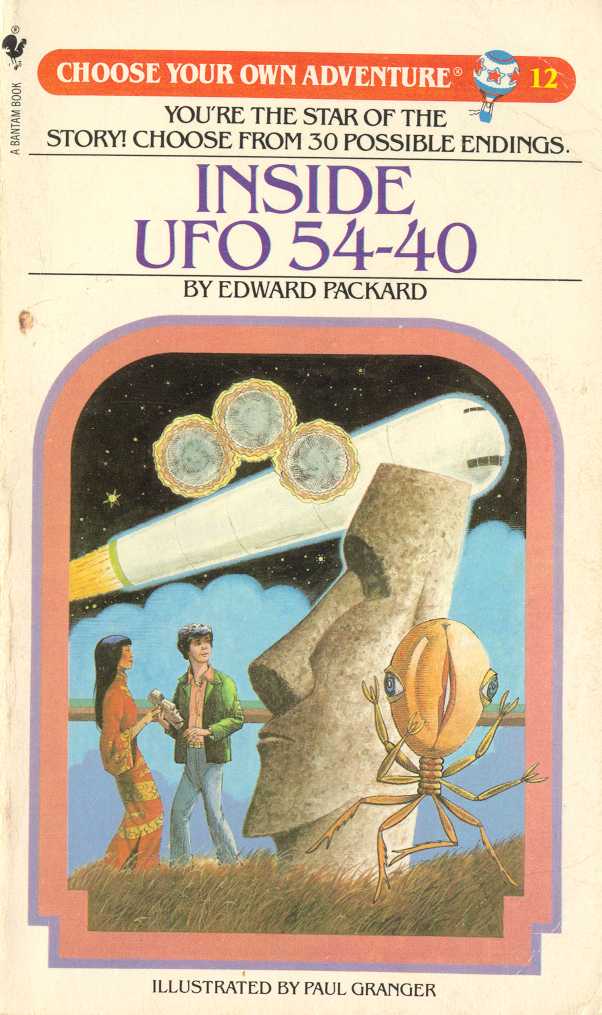
Remember those Choose Your Own Adventure books? If you’re of a certain age, you most certainly will. They were the ones where the narrative was all told second-person, about you the reader, and there were decision points in the narrative where you could choose this or that way to progress.
One of the very early books was entitled Inside UFO 54-40 (cover pic). In this, your protagonist ends up aboard a spaceship travelling in search of utopia.
Anyone who’s read one of these books knows that the way you interacted with them was never exactly as the book’s narrative assumed; you’d flick through pages at random and read entries for the thrill of seeing what might happen later on, you’d stop to look at art for entries you hadn’t yet reached, you’d keep your fingers in the pages so you could backtrack on your decisions if they turned out badly.
Flicking through Inside UFO 54-40 showed you that entry 101 was the grand finale, where you made it to Utopia at last, and success was yours!
Only one catch: the book was designed so that there was no way to ever reach entry 101. Utopia was unattainable.
That’s just wonderful.
—
Aside of extra geekiness: Inside UFO 54-40 was written by Edward Packard, who was the originator of the choose-your-path format. Those who, like me, assumed the format emerged out of the success of Dungeons & Dragons may be interested to hear that Packard wrote his first such book five years prior to the publication of D&D. (What, I wonder, would roleplaying look like today if it emerged from gamebooks instead of wargames?)
Pandas
I don’t normally post links to cute pictures. The entire rest of the internet does that.
Dammit, I have succumbed.
Lots of cute little panda cubs.
Wedding-o-rama
Muchas weddings this summer season. Tomorrow is the fifth or sixth (and last) I’m attending this season, and also the most important – my sister’s. First of us childer to marry herself off, and about time too (even if I do say so myself… it is a truth universally acknowledged, that a single man in possession of a blog must be in want of a wife, etc etc.)
So, with the travel in there too, it has been a busy time. There are some major things I want to write about here but I’m waiting until I have enough time to do them justice, instead of writing blog posts in unseemly haste like I’ve been doing all month.
Last night went to the International Wellington Ukulele Orchestra gig in the Botanic Gardens, part of a long series of free concerts in January. Their version of Outkast’s “Hey Ya” was my fave moment. Even though the weather has been memorably poor, and even though this is the only one I’ve been to this year, I understand it has been another good season of free gigs so far. A few more to come, as well as other free shows at the Petone festival and the Cuba festival and so forth. Truly, the abundance of free music in this city over summer is something to be treasured and celebrated.
People were out in force for the ukulele players, too – thousands of folk crammed into the soundshell area, they were turning people away it was so packed. Love it. And what I love best is the ukulele players maintain the session that started it all, gathering in Deluxe cafe at 8am on Thursdays once a month to play for people grabbing pre-work coffees.
Wellington’s ukulele champions have a website you can check out here. They play next at the Fringe festival picnic.
—
Tomorrow the wedding, and the long-delayed Return of the Kilt!
Teh Powar 2 Internet Destroy U!
Google’s crush on me has lessened somewhat – I’m not in the top ten results for ‘morgue’ any more – but it isn’t gone. (It doesn’t leave anonymous love notes in my locker any more, but it still writes ‘google 4 morgue 4 eva’ on the odd toilet wall.)
And a side effect of this is that some of my blog posts turn up really easily for people who might not be so happy about that.
For example, google ‘David Capitanchik’ and results 1 and 2 are posts of mine deriding prime nutbar David Capitanchik for some particularly boneheaded commentary on the risks of terrorism in the UK. (One of them is even entitled Capitanchik suxxor!) The man himself only turns up as result 3. Man, that’s cool. That’s kinda like victory.
My post on Monday about 8 Tribes is fourth on the google results for that search term. Not very complimentary about it, either.
I come 9th on searches for ‘Wellington Bypass’ – for linking to another blogger, as it happens.
So that’s quite nifty. Right now, for stuff at a certain level of obscurity, I can get some wicked Google impact. How can I use this power for good?
And, while I’m wondering, how can I avoid using this power for EVIL? For example, anyone googling ‘ernesto’s wellington’ will get my Ernesto – Disapppointing post first out of the box (and a bit further down if the apostrophe is skipped). That feels kinda bad. I went in there a couple times, and it did disappoint me, but that’s mostly because it’s a restaurant not a cafe. And, a lot of the concerns in that first post have been dealt with, like the table layout. I am misleading teh world! Should I really be feeling guilt about this? Well, probably not, because according to Sitemeter only one person has searched on those words in the last month. But. I guess, with great power, comes great responsibility…
And, er, coming second for searches on ‘childrape’ doesn’t exactly make me comfortable either. But if someone has to search for that term, my carefully-considered post about censorship might as well be what they see…
On RAW
Robert Anton Wilson died recently. Among many excellent responses to his passing, a brief one at Early Days of a Better Nation hits a personal bullseye:
What stuck in my memory were two concepts: the reality tunnel, and the SNAFU principle. The ‘reality tunnel’ refers to the tendency to notice only what confirms our beliefs. The SNAFU principle points out that in a hierarchy, each person tends to tell their superior what the superior wants to hear, i.e. what confirms their beliefs. By the time information reaches the top of a hierarchy it may be degraded beyond recognition. These two ideas explain much that is otherwise incomprehensible. We tend to assume that, whatever else may be said about them, our leaders are better informed than we are. If RAW’s insight is correct, they are likely to be far worse informed than the average citizen. (See? Suddenly, it all makes sense!)
Add these to your model of the world.
8 Tribes In New Zealand
8 Tribes: The Hidden Classes of New Zealand
8 Tribes calls an end to the myth of the “typical New Zealander” and gives us a new vocabulary to talk about New Zealand in the twenty first century. This snapshot of contemporary New Zealand explores our unspoken class system and the hidden social boundaries that separate us from each other.
On the same day I stumbled across this attractively-designed book in Unity, hottieperm stepped in to point out that it was, perhaps, unwise for the authors make quite so prominent use of the word ‘tribe’ to denote a lifestyle/values category. Quite apart from the fact that (as hottie p points out) NZ already has an important set of tribes, the word isn’t even well-deployed on its own terms. Clearly intended to echo the Wired-crowd’s adoption of the word ‘tribe’ to mean a community formed around a shared cultural interest set, the word is here used in a way neo-tribalists wouldn’t understand. (A throwaway comment on the 8 Tribes site that suggests you can change your tribal allegiance for 3 weeks at Christmas is really quite mind-boggling.)
In fact, there’s another word that fits this whole system rather better: stereotypes. The book presents eight stereotypes and calls them ‘tribes’. Like all stereotypes, the eight “tribes” have a superficial, prima facie legitimacy that gets them just far enough to start causing trouble. And like all stereotypes, when you look at them with a critical mindset, they collapse entirely. Luckily, the grandiose marketing language is just marketing. This isn’t going to be the new language for understanding New Zealand, and these aren’t the social boundaries that matter.
This isn’t meant to be a big hate-on for 8 Tribes. I don’t hold any malice for the book. I just think it’s really very silly, as if it was all just a livejournal meme that somehow found itself in a respectable bookshop despite being created by a Mountain-Dew-fuelled teenage girl between bouts of Hermione/Draco slashfic. And I think that New Zealanders, by and large, think the same, or will soon enouigh. So I anticipate the swift disappearance of the 8 Tribes idea from the great New Zealand conversation.