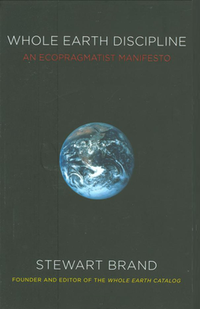
Just listened to Stewart Brand‘s Oct ’09 seminar for the Long Now Foundation, “Rethinking Green” (link to mp3). In it he gives a short overview of the key arguments in his new book Whole Earth Discipline.
Brand’s book pushes four ideas that run distinctly contrary to general green thinking:
Cities are green.
Nuclear power is green.
Genetic engineering is green.
Geoengineering is probably necessary.
His presentation in the seminar is very interesting, and makes some convincing points and some impressive claims. I’m on board with the first two, but I have a long way to go to be convinced of the second two.
Cities are green is a fascinating message, but let’s face it – it better be true, or we’re in trouble. The story of civilization is one of increasing urbanization, so if that doesn’t also push in a green direction then there’s no hope for humanity! Brand is mostly talking about the intense resource management happening in impoverished urban environments, particularly slums, and the hidden economies that operate there, but I would extend the point – cities have every chance of being highly green if they are properly managed. To take just one example: huge suburban sprawls, not so much. (By “managed” I mean mostly that economic/environmental signals are delivered cleanly to decisionmakers; urban planners have a place, but Jane Jacobs has described the perverse outcomes that result from management without understanding.)
Nuclear power is green is likewise fascinating, particularly here in nuclear-free New Zealand. In the seminar Brand says that there’s a new generation of green thinkers for whom nuclear is a solution, not a problem, because their world is dominated by climate change and not the cold war. I guess I’m sitting right on the cusp of that generational shift, but I am increasingly siding with the younger crowd. It seems to me that the problems and risks of nuclear (and they are many) are dwarfed by the climate change problem and the difficulty of addressing climate change through renewables and other energy sources. Nuclear is coming, in a big way; in the next decade or so, NZ is going to have to have a conversation about what that means for us.
Genetic engineering is green – here I wasn’t convinced. Brand enthusiastically talks about how much is possible with genetic engineering, even states that allowing it for impoverished countries is a moral imperative. He does have some good points to make here. However, he doesn’t address what to me is the overwhelming problem with GE, and that’s corporate control of the processes. In a world where Monsanto is already using GE technology to create a seed monopoly, there’s no reason for optimism. GE will – and already is – overwhelmingly used by corporations to maximise their revenue streams and their control over those streams, and the many other benefits for humanity won’t make it far out of a lab. I just can’t see a way for GE and GM to do anything other than perpetuate social inequality and put enormous control over human life in the hands of profit-driven companies. If someone can show me a way around that, then I’ll be happy to have a conversation about all the great things GE can do for us.
Geoengineering is probably necessary. This is talking about large-scale adjustment of the earth’s ecosphere to resist climate change. I retain an open mind on this, but the scale of these efforts, the potential consequences, the international co-ordination necessary (in his talk Brand himself references the lack of governance structures to handle countries using geoengineering against each other), and the sheer variety of scientific opinion mean I am unconvinced that it’s needed or that it’s doable. There are definitely people working furiously in this area, though, so in the next decade I expect this debate to develop hugely.
Overall, a stimulating talk that gave me much to think about. Recommended, including the Q&A at the end.