Symbolic Linky

Frrrrriday linky for your Frrrrriday

Perverse taxidermy: a contemplation of bizarre taxidermy from a museum perspective.

8 Historical symbols that mean the opposite of what you think

Who Tall Are You (Who is taller, Hoff or Cleese? THE ANSWER WILL SURPRISE YOU unless you get it right)

A lovely gallery of 50s-60s horror comic covers.

One-stop online shop for when you want to buy a private island.

God of War movie adaptation as Sundance-style indie flick:

This has been everywhere this week, but just in case: Mila’s Daydreams

Roger Ebert rips into BP with great vigour. (I’ve been bemused by the extent to which the Britishness of BP has been a factor in US anti-BP comment. Like multinational oil corporations based in the US would have done a better job?)

That’s not a knife. This is a knife.

And finally, via Suraya… bunny show-jumping

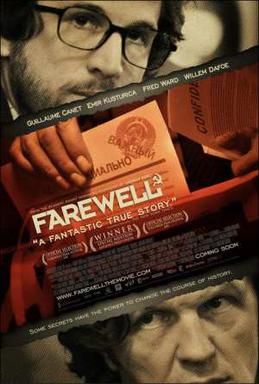
Farewell (France, 2009)

I was one of the many many people who saw this film at its Monday festival screening. Lots of familiar faces in the audience. Embassy Theatre was heaving. It’s a nice cinema always, but especially when it’s heaving.

So: this is a “based on a true story” of prominent 80s KGB informant Vladimir Vetrov, who passed secrets to the West that enabled the discovery and complete dismantling of substantial USSR infiltration of Western technology programmes. (Flicking through webpages on the subject, somewhere I read “the West was basically in a technological arms race with itself” because as soon as a breakthrough happened, the Russians caught up thanks to their network.)

It was enjoyable, if somewhat undisciplined, and (as is apparent from just a cursory search of Wikipedia) substantially divergent from what really happened. The filmmakers make no apologies for this – they renamed their informant for a reason. But it does make some of the familial relationships that drive the film feel a bit empty, knowing they were contrived for the film rather than summarised for it.

It’s a French film so it features men having affairs, a bearded protagonist, and lots of unscrupulous Americans. (One of the Americans is Willem Defoe, hurray!) There are actors in the roles of Mitterand, Reagan and Gorbachev, who verbalise the impact of the passed information. They were all fine in the roles of such well-known public figures, but I think the film would have been stronger if it found another way to show those aspects of the story. The strongest elements are the personal relationships around the spies – I was actually reminded of Donnie Brasco, a great filmic study of the familial costs of a life of deceit.

It’s a bit too broadly played to be fully satisfying, and knowing how far it was from the truth feels like a let-down to me, even though it made no claims to be anything other than a dramatic story that echoed some of the things that happened. But it was engaging and often genuinely suspenseful (although it pulled the same suspense trick twice for two of its tensest scenes, which felt like scriptwriting laziness to me). Above all, it’s very watchable. I had a good time watching it; I think most everyone would.

Plus, Freddie Mercury in white pants cameo as part of some Queen concert footage. On the giant Embassy screen… well. Those pants were tight.

La danse: The Paris Opéra Ballet (USA/France, 2009)

Those people who advised about going to see films without expectation or even choosing were right – this was not one I’d have chosen, and I think it’s my favourite of the five I’ve seen so far. We inherited tickets from my parents, who found late that they couldn’t go.

There’s not much film to sum up. US documentarian Frederick Wiseman takes his cameras inside the highly-respected Paris Opera Ballet, mostly into rehearsal rooms but also into administration offices, costume-workshops, and the rounds of the maintenance men. As the film goes on we see some of the actual performances, seven ballets in total from the traditional pleasures of the Nutcracker to a bunch of others I’d never seen before. It’s long, two-and-half hours, with extended sequences of nothing but dancers dancing and choreographers feeding back to them.

It was riveting.

I should clarify that I’m not a ballet aficionado in the slightest – I’ve seen, hmm, three ballet performances in my entire life, including last year’s Peter Pan. It’s a medium towards which I’ve never been drawn. That hasn’t stopped a strong thread of awe at what dancers do, and what they represent – the power and potential of movement alone, movement performed and experienced, and the many layers of communication that entails. Perhaps one of the reasons it isn’t my medium is because I’m so caught up with words, whereas dance is almost the opposite of words – one point in the film almost made me laugh as it addressed this so precisely, where a choreographer advised a dancer, as they talked through what the character might be thinking, “don’t put words to the movements or you’ll kill it”. And he was obviously right. Dance is a parallel track and its rules are different but no less potent for that.

This film, I felt, spoke to me very clearly about the creative process and creative expression, particularly shared and collaborative creativity. I was humbled by the sheer amount of work the dancers put into their craft, and pleased by their obvious joy in what they were doing. And as the film approached its end, and we started to see the ballets in performance, I found myself utterly caught up in the full realization of all that masterful development. Once or twice I might have forgotten to breathe.

I don’t want to oversell this film – as much as I loved it, I don’t know that I’d recommend it without caveats. It resonated with me personally, but I don’t know how another random person might take it. I don’t know that I’d watch it again, either. I think, if it sounds interesting to you, you’d probably enjoy it.

But yes, for me, this has been the highlight of my festival selection.

The Most Dangerous Man in America (USA, 2009)

Doco about Daniel Ellsberg, an ex-Marine Pentagon/Rand staffer whose eventual conclusion that Vietnam was unwinnable then turned to horror when he discovered that the U.S. had been the instigator from the beginning. Ellsberg then leaked the history of the origins of the Vietnam War, first to senators and congressmen who did nothing with the information, and then directly to the press. Cue uproar, and Nixon in full-on supervillain fury mode.

Ellsberg was disappointed that the leak didn’t have the impact he’d hoped. Predictably, the story became about him, not about the facts of the origins of Vietnam. The fury he must have felt watching the similarly contrived build-up to war in Iraq can only be guessed at; Ellsberg is depicted protesting against that war too.

I found this fascinating and educational. I only knew the broad strokes of this story, so it was great to have it unpacked and explored. And as much as Ellsberg was unhappy the story became about him, his personal story is indeed fascinating, such as his on-again off-again love affair with a woman tied to the peace movement while he was working in the Pentagon on the war.

I would have appreciated a bit more detail on the secret history Ellsberg was unveiling. The collusion of five U.S. Presidents in lying about Vietnam was sketched very briefly – a few more minutes on the subject seems worthwhile to me, as I expect many in the audience would be just as uncertain about the detail as I am.

Apart from that, a solid doco, well-made, about a subject that rewards the interest. It doesn’t strive to illuminate any higher truth, which is probably to its benefit. To be honest, it felt like reading a really well-written chunk of journalism from the New Yorker or the Atlantic Monthly, and I mostly mean that as a compliment but an also an observation about style. A lot of film docos use the medium to explore things no magazine article could touch, but I don’t think that was much the case here. This was a more traditional journalistic style, rigorous and eye-opening. Recommended.

Movie site

Yadirf Linky

Sometimes the gags take a while to come. Comedy is hard, man. But it’s nice to see my relatively weak gag in yesterday’s post get beautifully developed by C G in the comments. You should pop across to his Sleep Dep blog and the funny, weird rhythms of his Joe Korea story (starts here).

And while I’m talking about gags, this tweet about Kiwi Karl Urban being cast as Judge Dredd was met with silence. Obviously my genius will only be appreciated after my death. (Context for durty furriners.)

This was from Stephen Judd if I remember right: Bruce Lee’s audition for Green Hornet in ’64. Dude is charming and moves like lightning. For once YouTube comments not full of inane 14yo insults, instead full of comments about how damn hot Bruce is.

From Jenni, Young Me Now Me – I think this has been developed out of another “recreating old photos” site, because I recognized a couple of the pics I looked at, but in any case it’s lovely.

Lego tattoos. No, the other way around.

Mash brings down the Baudrillard in a response to the “how to fix Doctor Who” post linkied last week.

Hyper-realist painters. I find it odd that they almost all paint commercial products – post-Warhol I guess.

WWII reconsidered as a poorly-written TV series

My friend the Ruggerblogger is decamping to the Northern Hemisphere and expanding her rugby bloggery! Rugby enthusiasts would be well advised to read along with her.

In honour of SDCC, aka nerd prom, here’s Improv Everywhere doing Star Wars in a subway car.

And here’s a Brazilian site that’s probably saying something mean about Cosplayers photoshopping pics of themselves!

And finally, here’s an Instant Darth Vader Nooooooo button!

Mining Backdown

To the tune of “The Final Countdown”: it’s a mi-ning back-down… dada daa daa… dada da da da…

The government has abandoned plans to mine in highest-value conservation areas. Needless to say, this is a good thing, and stems directly from the massive public outcry.

As far as handling the backdown goes, the Nats are basically in denial mode. There are two lines you’ll hear in the official comments: “aren’t we great for being democratic?” and also “it was a worthwhile exercise because we’ve educated people about the natural resources available in this country”. (That’s if you even manage to hear them – National Radio this morning said they’d tried to get the PM to comment, but he’d declined saying only Gerry Brownlee would talk to this issue, and Brownlee’s office declined to speak as he’d already said enough on this matter. He didn’t even last out the 24-hour news cycle, poor dear.)

Both those official spin lines are weak to the point of comedy, and they suggest to me that the Nats, as previously speculated, are massively out of touch with our national identity. Moreover, the over-disciplined, almost paranoid and belated backdown suggests they still can’t quite believe it. I should clarify – I don’t think they’re amazed they got it wrong – I think they’re amazed that the electorate is so stupid that it can’t see they got it right!

But it was always about ideology, not facts. Brownlee never showed any convincing numbers about the simple value of this mining, let alone numbers that would somehow make despoiling prime conservation land all right. As much as the Nats would love for us to become Australia, we can’t give ourselves massive mineral reserves by wishful thinking. NZ’s valuable natural resources are its natural environments (both for tourism and for the “NZ brand” which has enormous value in the export market and on the global political stage) and its ecological security (which will see us ride out the water wars and food distribution breakdowns that will be the main story of the 21st century). I am unconvinced that there’s a single person in the National government who really understands how valuable these things are and how much better off we are than Oz.

Anyway. The Nats will continue with their plans to mine conservation land that isn’t high-value – the Labour government was happy to do the same, and I doubt the electorate is going to mobilise to stop them. The polls for the Nats haven’t shifted throughout this affair, so I doubt it’s even going to cost them much at the next election, unless opposition parties can effectively make this a campaign issue – and whether they can do that depends on what happens in the next few weeks. If Labour, in particular, doesn’t land some solid hits about this in the next fortnight, then it’ll be forgotten by voting time.

NZFF: Candyman (NZ/USA, 2010)

Next flim fevistal offering: Candyman. NZ filmmaker Costa Botes went to California to make this documentary about David Klein, the inventor of the Jelly Belly jellybean. This was a candy product that, not to overstate the case, revolutionised candy production in the U.S. (and, some speculate, helped humanise Ronald Reagan). Klein sold out of Jelly Belly in the 80s, for a pittance relative to the worth of his invention. More importantly, he has been written out of history by the Jelly Belly company, who simply do not acknowledge his existence.

So the film is a character study of an interesting character who had a great idea, followed it through with his heart and soul, then lost everything.

Klein is fascinating. He’s entrepreneurial and good at business operations, with an instinctive eye for marketing and branding – the Mad Men advertisers could learn something from him. But at the same time he’s compeletely not cut out for business-as-she-is-played. That fateful act of selling out was a ridiculous decision from any sensible business perspective. More importantly, Klein’s heart is not in profit at all – he marries his business sensibility to a deep love of helping people, regardless of the cost to himself. Unfailingly, stupidly, generous, he was never going to thrive in the world of real business.

So this is a fascinating doco looking at Klein, at who he is and what makes him tick, as well as the ins and outs of the Jelly Belly story. It will particularly resonate in the U.S. where this candy brand is a genuine cultural icon.

However, I can’t recommend this unreservedly. It felt, to me, like a 45 minute documentary packed into a 75 minute package. There wasn’t enough in it to sustain my enthusiasm.

So: very good, but not great.

(And, special mention to the music by Lower Hutt’s finest, Tom McLeod. Music in a doco is often hard to get right, but this was a delight – it’s no surprise Costa made special mention of it when introducing the film.)