Dec 31st, 1999


(THE LAST DAY OF EXISTENCE)
The car is parked on the Napier waterfront & I’m in the front listening to the thud of bass. People movement. A day that has been foreseen for so long. I drove up alone in two stretches, a break at PN, the exultation of geography, the Manawatu Gorge. I realised why mother begged the kids to look we had to be her eyes, it was our duty to experience & appreciate simply because we could…
…just saw Aurora and her flatmate Cassie, here w/ Aurora’s band-boy, we get ice cream and now I have chocolate topping on my beach pants. Symbolise that!
Sunlight is caught up in grey clouds like it can’t kick through. I feel underneath. And, oddly, far from alone.
I’ve referred to tonight’s soloist escapade as a happy suicide. I’m using it, this festival, to reiterate my preference for isolation, to focus and refocus in, to strip myself down. 8 years ago tonight I changed, started on a road that has led here, away from all who I know – alone in a crowd. So easy to interpret life as narrative and see the precursors to this, images and themes echoing back and down through years. 1999 has been a culmination, bringing a new freedom, the entirety of which I am only just beginning to appreciate. I have removed my cultured self by layers, folding each back and sloughing it off, and now I’m learning to live without guides and structures, not of time or need or respect; there is only one more category to lose now and that is Me as Me. Happy suicide; tonight I remove even my self. Like the years, I parcel it up and lock it away and move on, a new cycle, build a door just to open it, and free of feedback I move to dawn.
The Air India hijack continues a week on. Giant speaker stacks are playing ‘party like it’s 1999…’
Party like it’s now.


I kept a journal through 1999. Reading over some of it recently, I realise how much of it is coded so only I will ever see most of the content – this entry contains literally dozens of loaded words, packing in context and references that only I will get. But I want to take a moment on this blog to record that moment ten years (er, and a month) ago when I finished the journal, finished the 90s, and finished an eight-year process of ‘learning to live without guides or structures’. I can’t imagine myself without that process. It was how I created a version of myself I could properly and happily be.
Perhaps significantly, about three weeks after writing the above entry I met Cal for the first time.

Stewart Brand on Green


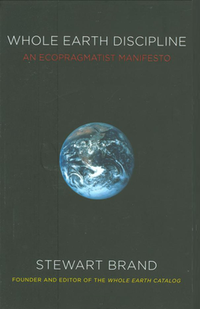
Just listened to Stewart Brand‘s Oct ’09 seminar for the Long Now Foundation, “Rethinking Green” (link to mp3). In it he gives a short overview of the key arguments in his new book Whole Earth Discipline.
Brand’s book pushes four ideas that run distinctly contrary to general green thinking:
Cities are green.
Nuclear power is green.
Genetic engineering is green.
Geoengineering is probably necessary.

His presentation in the seminar is very interesting, and makes some convincing points and some impressive claims. I’m on board with the first two, but I have a long way to go to be convinced of the second two.
Cities are green is a fascinating message, but let’s face it – it better be true, or we’re in trouble. The story of civilization is one of increasing urbanization, so if that doesn’t also push in a green direction then there’s no hope for humanity! Brand is mostly talking about the intense resource management happening in impoverished urban environments, particularly slums, and the hidden economies that operate there, but I would extend the point – cities have every chance of being highly green if they are properly managed. To take just one example: huge suburban sprawls, not so much. (By “managed” I mean mostly that economic/environmental signals are delivered cleanly to decisionmakers; urban planners have a place, but Jane Jacobs has described the perverse outcomes that result from management without understanding.)
Nuclear power is green is likewise fascinating, particularly here in nuclear-free New Zealand. In the seminar Brand says that there’s a new generation of green thinkers for whom nuclear is a solution, not a problem, because their world is dominated by climate change and not the cold war. I guess I’m sitting right on the cusp of that generational shift, but I am increasingly siding with the younger crowd. It seems to me that the problems and risks of nuclear (and they are many) are dwarfed by the climate change problem and the difficulty of addressing climate change through renewables and other energy sources. Nuclear is coming, in a big way; in the next decade or so, NZ is going to have to have a conversation about what that means for us.
Genetic engineering is green – here I wasn’t convinced. Brand enthusiastically talks about how much is possible with genetic engineering, even states that allowing it for impoverished countries is a moral imperative. He does have some good points to make here. However, he doesn’t address what to me is the overwhelming problem with GE, and that’s corporate control of the processes. In a world where Monsanto is already using GE technology to create a seed monopoly, there’s no reason for optimism. GE will – and already is – overwhelmingly used by corporations to maximise their revenue streams and their control over those streams, and the many other benefits for humanity won’t make it far out of a lab. I just can’t see a way for GE and GM to do anything other than perpetuate social inequality and put enormous control over human life in the hands of profit-driven companies. If someone can show me a way around that, then I’ll be happy to have a conversation about all the great things GE can do for us.
Geoengineering is probably necessary. This is talking about large-scale adjustment of the earth’s ecosphere to resist climate change. I retain an open mind on this, but the scale of these efforts, the potential consequences, the international co-ordination necessary (in his talk Brand himself references the lack of governance structures to handle countries using geoengineering against each other), and the sheer variety of scientific opinion mean I am unconvinced that it’s needed or that it’s doable. There are definitely people working furiously in this area, though, so in the next decade I expect this debate to develop hugely.
Overall, a stimulating talk that gave me much to think about. Recommended, including the Q&A at the end.

New chair


Beautiful wife persuaded me that it was time to get a new chair. Through careful viewing of photographic comparison above, an alert reader may notice some slight differences between the two chairs, namely that one is a tiny bent hollow with a back that doesn’t go up any more, whereas the other is a majestic throne with a high, curving back.
Should have done this years ago. If this improves my comfort levels a tenth as much as the ergo keyboard has, it will be money very well spent.
Note, also, that the chair’s back curves away from the lower back, rather than in toward the neck. I only mention this because every time I get on a plane it’s bloody torture on account of some genius who thinks chairs should have convex backs, particularly if you have to sit in them for twenty-two hours. Arg.
Ahhh. The comfy chair.

Waitangi Day


2010’s Waitangi Day passed in peaceful fashion, with some surprising symbolism. The tino rangatiratanga flag, representing Maori aspirations for self-governance, was officially flown outside Parliament. Prime Minister John Key went on to Waitangi marae arm-in-arm with perennial Waitangi powerhouse Titewhai Harawira, both of them politely ignoring the series of fierce battles that keep erupting between Key’s government and Titewhai’s most prominent son Hone.
All this suggests to me something of a Nixon-to-China effect. There’s been significant grumbling from National’s base even though the decisions are coming from their leadership, and I can only imagine the response if a left-leaning Labour government had taken these steps*. It may be that this National government, whatever else it does, might deliver a significant step forward in NZ race relations. Two steps, even.
* Of course, relations between Labour and Maoridom were in tatters by the end of Labour’s run, so Auntie Helen wouldn’t have been able to do this anyway.
National has made huge ground from its agreement with the Maori Party. It gains legitimacy, credibility and mana from working with them and maintaining a solid relationship. I think it works in their favour to hit back hard against Hone Harawira; as long as the relationship overall remains strong, a bit of a stoush is entirely appropriate. It’s a continual big win for the Nats.
Not so sure about the Maori Party. It seems to me they’re playing a long game, looking to establish themselves as a political presence and build good relationships into the major political parties. But Harawira’s regular outbursts are emblematic of what they’re not doing, which is spending any political capital against some of National’s more egregious policy moves. Balancing long-term political viability against the well-being of their constituency is a tricky road, and I don’t envy the decisions they must be forced into making in caucus.
Anyway, aside from all that, it’s nice to see a Waitangi Day that is chilled out. Perhaps no coincidence that it fell on a weekend this year – why would anyone want to spoil a perfectly nice sunny Saturday with all that politics?

Sevens Linky

All over Wellington, people are dressing up in the crazy costumes because the Rugby Sevens are in town!
But here are some unrelated linky.
First-person tetris. I can’t bear to play this, and the music reminds me of when I used to dream tetris. Did you ever dream tetris? There’s a wiki article on the Tetris effect that is worth a read.
Pass Fail – using visual design/usability principles to make boarding passes more useful. Compare the designs and be enlightened about how uselessly most information is presented to us. (Notably, the fantastic Air New Zealand boarding pass is given a significant thumbs up – it’s obvious why, when you compare it to what else is out there.)
Did aliens play a role in Woolworths? I think I first saw this via Public Address, but it’s been around a bit, for good reason.
Stray dogs in Moscow – absolutely fascinating.
Following from the 39 Steps discussed a couple days ago, here’s the BBC’s 21 Steps, a story told in interactive form. It doesn’t load for me at all, sadly, but it sounds very interesting – maybe someone out there can get it to go?
The Society of Unordinary Young Ladies – comic in which the female characters from 80s sitcoms team up to fight crime.
(Facebook) Ant Timpson provides a lengthy interview with the guy behind seminal mash-up video experience, Apocalypse Pooh.
And finally… Japanese Chewbacca loves Sea Chicken!

Gallery Dots


Yesterday, I cashed in some of my time-in-lieu and left work early to spend the rest of the day wandering in the sunshine. I was in an unusual head-space, mentally and physically restless while seeing the familiar Wellington scenery with fresh eyes. I was approached by a couple of young mormon missionaries and had a pleasant chat with them, then decided to go and see the dots.
“The dots” is what Wellington has come to call the City Gallery’s exhibition, Yayoi Kusama: Mirrored Years. Kusama’s immersive and engaging work has proved a huge success, drawing big crowds, and the City Gallery building itself has been covered with dots in honour of Kusama’s iconography.
I thoroughly enjoyed the exhibition. There were some lovely mirrored spaces that provided a fully immersive environment, and the two “Dots Obsession” rooms containing gigantic 3D shapes were imaginative and powerful.
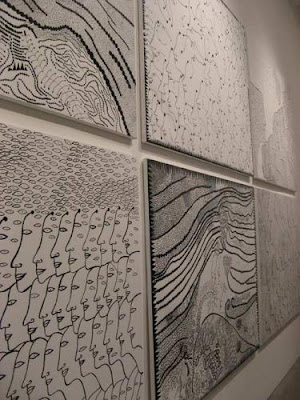
However, I found that it was the smaller, less dramatic works that had a bigger effect on me, if you can call these giant canvases small. Here’s one that takes up an entire wall: Stars Obsession A, B, C (This may not be the specific painting on display in Wellington, but it’s part of this series at least.) This image revealed new aspects of itself as I stood in different relation to it, and I particularly loved how my initial impression of simplicity when close by (forced by the gallery, which put another object close creating only a narrow walking channel) was completely unseated when I viewed it again from further off and saw how subtle colour gradations gave an incredible texture and depth to the image.

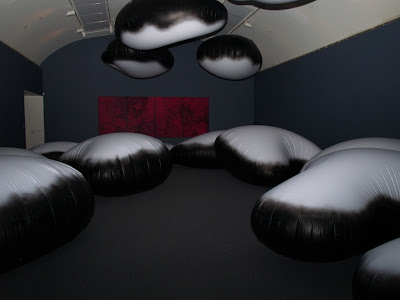
I’m curious about whether the curators at City Gallery did that deliberately, placing another object to force that contrast of perceptions from up close (on one side) and far away (on the other). The exhibition has not been supervised by Kusama, who has not come to New Zealand with her work. Curators have been given significant freedom in arranging and presenting the work. In the initial flurry of interest in the show, this was a frequent negative talking point in the Wellington media, but it has disappeared completely since the show’s success became obvious. For my part, there’s only one curatorial decision that seems wrong to me, and that’s the juxtaposition of the “clouds” works (here they are in Sydney) with these large black-and-white canvases full of obsessively repeated motifs. I didn’t think these works had much to do with each other, and the fact that they’re both monochrome overwhelmed any other aspects of either set. (Of course, this might have been a space issue – this is a big show, and compromises will have been needed somewhere.)
My favourite piece was one of the simplest, and also one where curatorial input mattered a great deal. Kusama’s Narcissus Garden consists of a large number of football-sized mirrored spheres. In the City Gallery, they have put this piece in the space directly across from the entrance hall, a big wooden floor with windows at the end. The spheres are arranged right up against the walls, up to six balls deep, as if they have rippled out there from the centre. The more I stayed in this space (which, given its unassuming character and proximity to the coat-check, took me a while to properly appreciate) the more it had an effect on me. The mirrored spheres crowding against the walls seemed to be retreating from me, trying to push themselves as far from me as possible, like magnets repelling each other. My reflection in every sphere thoroughly implicated me in this. There was an undeniable emotional level to the experience too, as though I was responsible for an unsettling disequilibrium. The piece resolved itself into something quite emotionally aggressive, not remotely pleasant, but something that seized me and forced me to consider how to move on from it. (That last is always a sign that an artwork has grabbed me.)
So, I really loved that piece, and it was easily the highlight of the show for me. But here’s the thing – my experience, I’m certain, is nothing like what was intended by the artist. Narcissus Garden was launched in an infamous art-prank in 1966, when Kusama turned up at the Venice Biennale with the full piece and proceeded to hawk off the spheres for a couple bucks a pop. A photo of that incident shows the spheres all sat together on a small grassed plot. When they install this piece, curators have to make their own decisions about what to do with the mass of silver balls. A google image search shows the variety of solutions that different galleries have adopted. The City Gallery decision to push them to the edges of a large space is quite unlike the choices made elsewhere.
So where does that leave my experience of the piece? I am fascinated, to be honest, by the fact that my interaction with it wouldn’t have happened at any other Kusama show in the world. What this does is highlight for me just how much engaging with artwork is a fundamentally creative act. To me, and this will surprise no-one who knows the patterns lodged in my thinking, art is about interaction. Artworks are an opportunity for us to create personal responses through our experience, and the back-and-forth between these two is where everything of value and meaning happens.
Or, put another way, art is a game we play.
The show finishes on Sunday. If you’re in Wellington, it’s worth the effort to go see the dots.
DVDs, 39 Steps

My brain is still in recovery mode from that intense January. Still busy at work but I’m being careful to use my downtime for down. This is something of a change, I realize. Example: for the first time ever, I’m watching a TV series* on DVD by myself. Just cuing up the next episode when the previous is done feels very strange to me, like that time in ’98 when I was getting paid to watch an empty room and surf the internet. How can this be allowed?
* Lost season 1, actually. I downloaded the very first episode of Lost right after broadcast but didn’t get around to watching it that week, then decided I couldn’t be bothered catching up. I’ve told anyone who’s listened that I’d only give Lost a try when the whole series was complete and they had demonstrated they knew what they were doing. Well, the buzz about the final season has convinced me to give it a try. Ten episodes in, I’m not exactly hooked, but it’s very watchable. But slow. Man, but this show takes its time. I’m confident you could edit every episode down to about 22 minutes and not lose any content. Losties, are there episodes worth skipping entirely?

Last Friday Cal and I went to see The 39 Steps at Circa. Theatre for the win – so much more fun than cinema. The show is in a revival season, and it’s obvious why – a highly energetic farce that throws out gag after gag without pausing for breath. Not all of it worked for me, but there’s always another bit just around the corner, and the sheer enthusiasm on display won me (and everyone else) over. The performers were dropping lines and corpsing all over the place, because they could get away with it in this show, and their ad libs were some of the best bits. Great fun. We were sitting next to a drunken Irishman who’d seen the show in London and announced that this was “completely different” (in fact he announced it every few minutes, while the performance was underway), and finally said he thought this one was even better than the London one. So, drunken Irishman seal of approval there. It’s on until the 13th, Welly folk – go see it.
Minor achievement at basketball last night: you know that bit where the score is tied and the guy in the movie is fouled with no time left and has to go to the free throw line and win the game from there, with the whole stadium watching? I was that guy, and made the second of the two shots so we won. But that wasn’t the achievement. The achievement was that we, as a team, called a time out with 3 seconds left, decided how we would use those final 3 seconds, and then executed our plan perfectly. In all my long years of playing basketball, that has never happened before. I was proud of us. Nice one team.

Dollhouse S2 (No spoilers)

Season two of Dollhouse was great TV.
Dollhouse is still the strangest TV series I’ve ever encountered. Structurally it is *bizarre*.
The creative team never figured out what to do with the premise. They knew, right from the start, that they were sitting on a goldmine of weird and interesting and potent material. They spent all of both seasons trying to work out how to exploit it, and never quite managing.
However, they certainly created some memorable, challenging TV along the way.
The final episode, in what must be a first for any TV series, is a broadcast sequel to an episode available only on DVD. It’s a fun ride, and gets away with its cringey moments by just packing in so much stuff. It doesn’t really function as a thematic capper, it doesn’t make a final statement about the ideas in the show, and the writers still haven’t worked out what to do with their star and her character(s). But it made me think a couple times, and it did great work on the secondary characters.
Watch it sometime. It won’t be your new favourite TV show, but it carries its weight, and it’s downright provocative. I’m glad it happened.
And watch out for this guy, find-of-the-series Enver Gjokaj: dude can act like wow.

CalMorgue: 1

(Let’s give this blogging thing another go, shall we?)
Cal and I got civilized a year ago. Anniversary was a week ago. It has come up a year awful quick.
Main thing about it being a year on is, people don’t say “how’s married life?” quite so often.
– which is almost ironic because it’s only this deep that you start to work out an answer to that question. Namely, it’s much the same but awesomer. It feels different. Like climbing up to a hilltop lookout, the horizon gets further away and the view gets more interesting.
How patient is my Cal? I went role-playing on our wedding anniversary day. That is hella patient.
My love for Cal: [@now]>[@then]


This gives me another excuse to post Steve Leon’s lovely highlight reel, too.