Move along

Nothing to see here, just trying some stuff out.

This is the Asian Association of Social Psychologists.

The url is http://www.asiansocialpsych.org/

Some of these people are my friends, but that’s not important right now. What matters is, I need to try some stuff in relation to their site, and I need an external link to play with. So this is that external link.

Seriously, carry on. This is boring work stuff. Apologies for the interruption to your day.

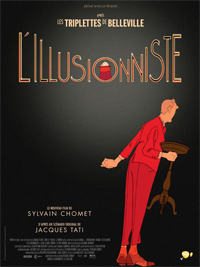
NZFF: The Illusionist (UK/France, 2010)

First Flim Fevistal experience of the year was this animated piece by the fine minds behind Triplets of Belleville. It’s an adaptation of an unproduced (and apparently deeply personal) script by French comic filmmaker Jacques Tati. In the fading years of Vaudeville, a stage illusionist travels where the work takes him, and in the Scottish Highlands he acquires a young girl who is enchanted by him and believes his magic is real. The remainder of the film plays out in Edinburgh, as the illusionist tries to make ends meet, and the girl – a true naif – starts learning a thing or two about life.

We bought the tickets to this one based on Katie’s recommendation on my grumpy-about-film post. It was indeed a stunningly beautiful rendering of Edinburgh, enough to load me with a heavy shot of missing the place. That mood sat well with the film itself, which was gentle and wry and shot through with sadness, right to its final frame. Not a happy movie at all. It didn’t fully transport me, principally because the story never quite resolved its fable-aspects with its realistic-aspects, but it kept me engaged and fascinated throughout, and the ending was marvellously right. (And endings are so very, very difficult to do well.)

So, a successful outing. Good flim. Has chipped away some of the film-grumpiness of recent times.

Next NZFF: Candyman. (Not the guy wth the hook – the guy with the jellybeans.)

Flight Day Linky

Just collected parents from airport where they were returning from that North America. They seemed wired and tired at the same time – I remember that feeling.

Here are some wired/tired linky for your wired/tired Friday.

Awesome life-size dinosaur puppets.

Password Card – remember more secure passwords.

A secret station on the London Underground, three floors above street level. And via Malc, here’s a tour of a tube station abandoned in 1938.

I haven’t listened to any of this yet, but: free album download – a tribute to Doctor Who. Presumably contains the only Doctor-Who-themed hip hop you will ever need.
Also, via Jamas: fixing the latest Doctor Who season. Worth a look if you’re a writer type and know what happened in season 5 of Who which hasn’t finished yet in NZ, spoiler warning.

Crazy U.S. right-wing pundit launches own university. This happened a while back but I was thinking about it again in light of the Krugman book. It is still mental.

Cute little AT-AT:

Hippy kitchens

From Maire, a science-based discussion of gender differences in little childrens: Out with Pink and Blue

And finally: art exhibition inspired by Law & Order episode summaries. (Features Kate Beaton!)

“Conscience of a Liberal”

Train reading over the last little while (when not listening to the Mayo/Kermode podcast) has been Paul Krugman’s The Conscience of a Liberal: Reclaiming America From The Right (2007, this edition paperback with new foreword from 2009).

The book is essentially a history of “how we (the U.S.) got into this mess”, combined with an emphatic reminder “yes, this is a mess”. It tracks through the last century-plus, where the Long Gilded Age of massive inequality was succeeded by the New Deal which introduced a welfare state and (with the help of some wartime measures) brought about what Krugman calls “the great compression”, where the extremes of inequality shrunk massively and the U.S. became a middle-class nation.

Then it tracks the rise of movement conservatism through its capture of the Republican party, and shows how the political shifts from Reagan onwards pushed inequality back towards Gilded Age levels. And it does all of this from an explicitly liberal, progressive viewpoint (Krugman discusses the use of both terms) that gives a prescription for pulling back from inequality and, crucially, completing the New Deal by developing health care for all.

It’s a great and readable book, putting a framework around a lot of things I only knew in bits and pieces. It’s a refreshingly candid argument, too, with an appeal to the fundamental morality of political liberalism and a reminder that it is liberals who are always on the side of democracy:

When liberals and conservatives clash over voter rights in America today, liberals are always trying to enfranchise citizens, while conservatives are always trying to block some citizens from voting. When they clash over government prerogatives, liberals are always the defenders of due process, while conservatives insist that those in power have the right to do as they please. After 9/11 the Bush administration tried to foster a deeply un-American political climate in which any criticism of the president was considered unpatriotic – and with few exceptions, American conversatives cheered. (p267)

Implicit in Krugman’s argument, but mostly unexplored in favour of other lines of discussion, is the power of social identity in shaping politics. Krugman gives convincing evidence that America is in fact a liberal country – that when you poll Americans on policy initiatives they would support, liberal policies are highly favoured. However, many of these same people identify as Conservatives. This is partly thanks to movement conservative’s skill at putting values issues to the forefront, a trick learned from Nixon; partly it’s a legacy of endemic racism in the US. In fact, if there’s anything in Krugman’s book that shocked me, it was his matter-of-fact conclusion that racism in the U.S. – specifically, the race relations problems that are the legacy of the slave trade – is the point of differentiation that explains why the US is so different to its neighbours and contemporaries. Since Reagan’s “welfare queens” comment, the hidden element of economic discussions in the US is that supporting poor people means supporting black people, and that is not a vote-winner.

Krugman gives a good account of the rise of movement conservatism. This was a small set of intellectuals in favour of minimal government and unregulated economic activity, and who saw the welfare state as anathema. They developed over time into a complex system of media channels, think tanks, and political operations that co-operate and, crucially, protect their own by circling them around through the system while ejecting those who stand against them (e.g. by shifting towards a more Eisenhower-Republican stance). However, he doesn’t have much to say about why people become movement conservatives – about the appeal of the ideology, in its purist form as well as its popularized (tea party) form. (The tea party movement hadn’t happened at the time Krugman wrote, of course, but the elements of it could be seen in the Joe-the-Plumber/Sarah Palin crowds.) To be fair, that’s well out of Krugman’s area, but I would have appreciated some comment from him on this. Movement conservatism, it seems clear from Krugman’s account, is not fundamentally concerned with social dividers like race and homosexuality. Movement conversatism is about the relationship between wealth and government, which are not identity issues in the normal sense; and yet the ideology seems to resonate as powerfully as any identity politics might.

This post hasn’t been a very good review or description of the book, more some random musings that it has prompted in me, but there you go. As usual, reading about the U.S. political scene is an exercise in wonder and frustration for me as a non-U.S.ian, but the influence of the U.S.A., and of movement conservatism, is clearly felt over here in countless ways so this kind of understanding is very handy. Book now available for borrowing, Wgtn/Hutt folks!
Predators (USA, 2010)

Yeah, so, remember how I was all down on cinema and not interested in movies? Well we had a sporting break on another cheap night, and when the invitation came down to go see Predators, I couldn’t resist. After all, I have much love for the original film and its under-rated sequel, and it’s been a long time since we’ve seen the dreadlocked hunters in action. Because there have been no films featuring them since the 90s. None.

And it was mostly a great popcorn flick. I enjoyed it, on average. Some of it I really enjoyed. Some of it I was bored. The whole final battle made no sense at all, as did the introduction of a second variety of Predators who act exactly the same as the first variety, except they maybe squat-and-roar-in-triumph a bit more often. Having the classic monster humbled by the new monster is a fine way to garner cheap heat, but nothing at all was done with it.

But! Exactly as advertised, there were a bunch of morally-dubious anti-heroes being stalked and killed one-by-one by alien hunters, and that was fine by me.

The highlight: when all the cast gather ’round as one of their number spends a full minute describing, in some detail, the complete plot of the original film.

The other highlight: realizing that the key moment in the trailer wasn’t actually in the movie, but was a quite different movie scene digitally altered specifically to create that key moment in the trailer.

The recommendation: watch as a cheap video with friends, or as a cheap movie with friends, or don’t, because whatever. Actually, watch Predator 2 again, because Danny Glover and Gary Busey, that’s why.

So I guess I’m cured, right?

The Knifeman, following that earlier movie-blah post, sent me a challenge to only watch unpopular movies for six months. “At the end, your view of movies will almost certainly be altered forever.” It’s tempting, but I’m going to decline, if only because I don’t want to spend the last six months I have before baby arrives banned from watching movies that might be good…

I invite him to share the details of this challenge, or speak more of the value of such an exercise, if he is so moved.

I like to be / Under the sea

Paul the Octopus has a perfect prediction record in the World Cup.

We all live in the octopus’ garden now.

[Octopi are very smart creatures. You present it with two boxes labelled A and B, and it goes to A and finds food. Then you present it with A and C, then A and D, then A and E… mostly it’ll go to A because it has learned that A holds tasty food, and it isn’t sure about the other option. Germany’s winning record meant Paul’s tendency to go for the familiar option was a sound strategy.]

[Of course, Paul is still psychic because he knew to go to the other option in the Serbia game.]

Things only NZL cares about dept.: the only undefeated team in the World Cup = NZL.

Frid-Oink! Linky

Still busy, as you can tell from posting frequency. Still, some linky for a rainy Wellington Friday.

Twilight Eclipse: The interactive YouTube experience, performed as an 8-bit game. Weirdness. More my speed: the not-your-regular-critics insight of What do young women really talk about when they talk about The Twilight Saga: Eclipse?

Fuhgeddabout the Broadway Julie Taymor/U2 failstravaganza Spider-Man: Turn Off The Dark. The webbed wonder already has his rock opera, Spider-Man: Rock Reflections Of A Super Hero – and you can experience the best 70s-tastic songs from it right here.

Dr Bunny brings the science with a round-up of great reality-based linky that you should really check out. Includes bonus Elmo!

Simon Pegg and Nick Frost have been eaten by ghosts

Oink! was mentioned mid-week, re: Frank Sidebottom. It was bloody great, that comic. Find out more here. Read some early, great issues here. And buried in the NotBBC site is this magazine based on the TV show the Oink! team all worked on next, Round The Bend.

But the biggest delight I’ve had in googling up Oink! was discovering that the two songs on the bonus flexidisc that came with the first issue are up for listening on Tony Husband’s site. I haven’t heard these songs in at least twenty years. I still know all the words. Glorious. (Apparently John Peel played them on his show!)

And finally, via William Gibson of all people, the trailer to Beach Girls and the Monster

Frank Sidebottom RIP


I didn’t know what the hell to make of this when I was a kid reading Oink! comic. One of those inexplicable British things that, as a Kiwi kid, you encountered from time to time in the UK’s pop-culture output.

Frank Sidebottom was the creation of Chris Sievey, and it was somewhere between comic genius and outsider art. Sievey died last week, only 54 years old.

Frank Sidebottom was punk. He was, he really was.

Lew Stringer discusses Sievey’s Oink! work.

Google also turned up this lovely story.